3. The Observers Above
The author, with a dialogue interlude.
The third layer. The rectangle under the Vostok ice. The same rectangle in two other oceans. The man at Starbucks's "nearby galaxies" claim, taken seriously without being believed.
▼ in this chapter — 23 entries
3. The Observers Above
The man at the Starbucks patio was telling the truth obliquely, with the wrong vocabulary. He was stable. He was not, in any of the ways the apparatus’s media-watch desk has learned to score for tier, scoring. He had a faint accent I could not place — Czech, maybe — and a wedding ring he had not removed in long enough that the band of pale skin underneath had given up on returning to color. He said his former leadership could travel to nearby galaxies. He said it the way another man might say his former employer had warehouses in Memphis.
I have thought about him for fourteen months — not because he is the strangest person I have spoken to about this material (he is not in the top fifty), but because his sentence does not fit the account I had thought I was assembling. The operators are planet-resident. They have been for twelve thousand years on the human-relevant clock, longer on every other one. They do not go to nearby galaxies. They do not, as far as anyone reading the maintenance records can tell, go to the moon. The operators stayed. So whatever the man’s former leadership was, it was not the operator class. It was, if it was anything at all, the layer above them — the one with no signatory page on the bilateral accommodation and no return address on the planet. The third layer. The observers.
This chapter is about the third layer, and about why a stable man who probably could not have told you what an actuarial review is would have, in a confabulation or a memory or a thing he could not tell apart from either, latched onto the exact element of the picture the apparatus would most prefer he had not.
I. The shape under the ice
The clearest physical evidence for the existence of the observer class is a rectangle. I want to take that sentence apart carefully. The looseness with which it can be said hides how strange it is.
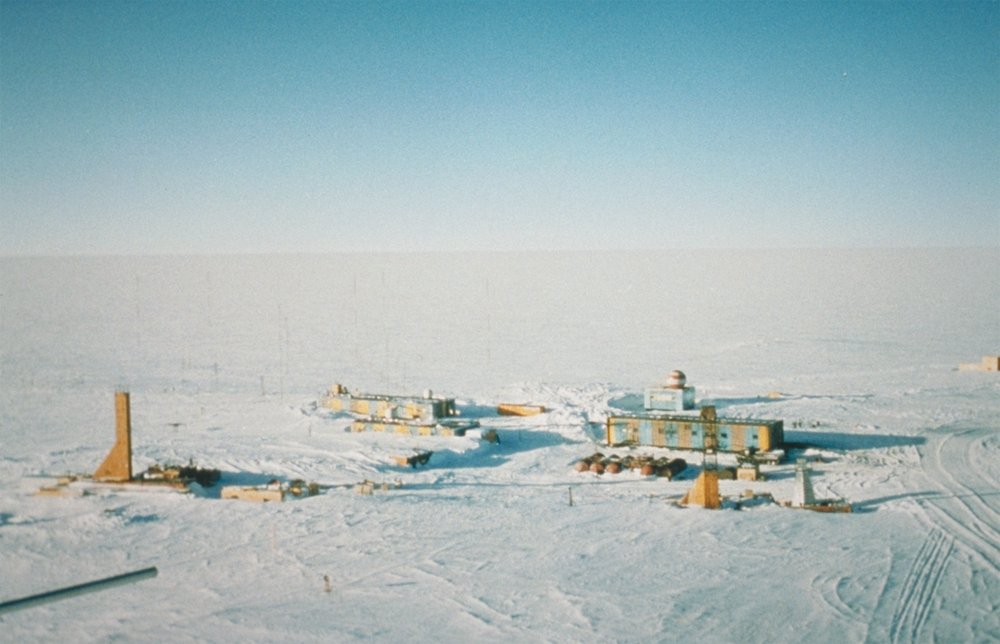
In 1995, Robin E. Bell and several colleagues at Lamont-Doherty published an airborne-geophysics analysis of the Lake Vostok region. The Bell group’s contribution was the magnetic and gravity data. Their 2002 paper in Nature, with Studinger and several others, reported a feature on the lake’s eastern margin that the body of the paper called a magnetic anomaly. The figures were less guarded. The figures show, in the residual magnetic-intensity map, a rectangle.
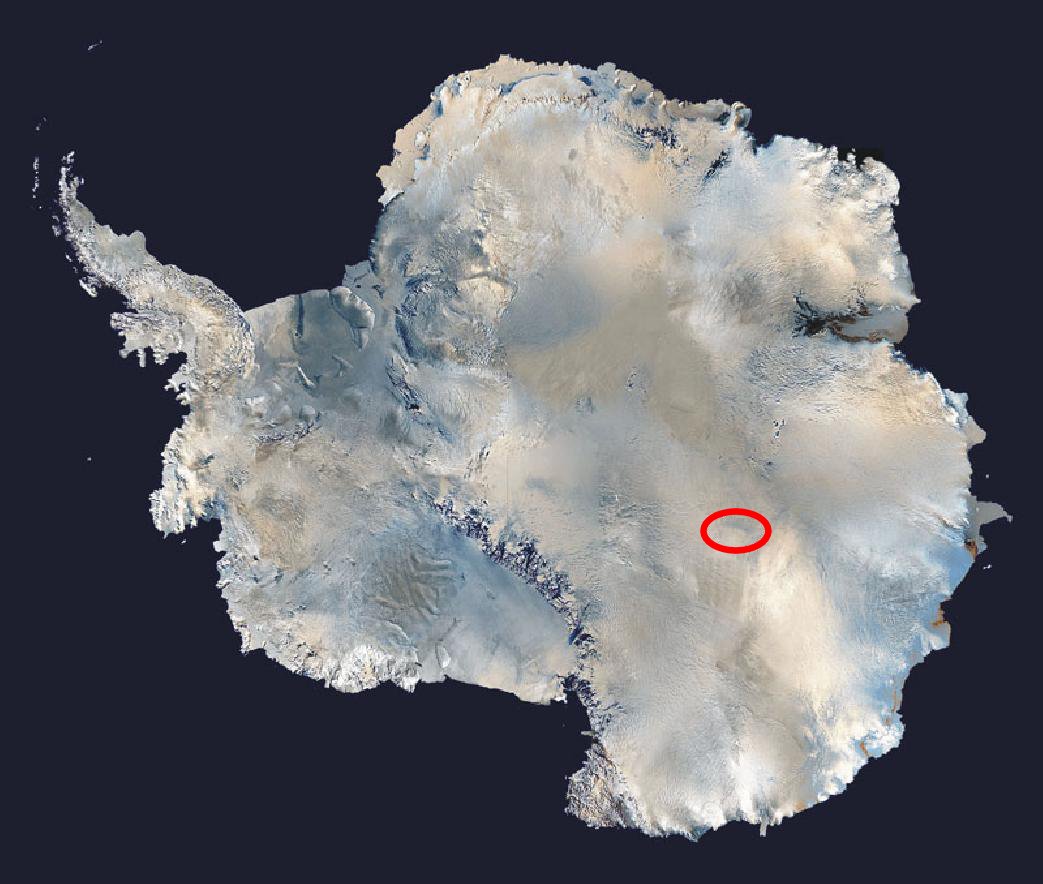
The rectangle is approximately 105 kilometers by 75 kilometers. Its long axis is oriented roughly north-northeast to south-southwest. Its edges, as the residual-anomaly grid renders them, are straight to within the resolution of the survey. It sits beneath roughly four kilometers of ice along the eastern shoreline of the lake, in a region of subglacial topography that is otherwise unremarkable: a bedrock platform sloping gently east, no obvious tectonic fabric, no comparable rectangular signatures within a thousand kilometers. The Bell authors proposed, with appropriate caution, that the feature might reflect a buried sedimentary basin of unusual composition, or a deeply buried intrusive body, or “an as-yet-uncharacterized basement feature warranting further investigation.”1
Further investigation did not characterize it. Successive airborne surveys — the BAS aerogeophysical traverses, the AGAP campaigns, the gravity inversions of Filina and others through 2008 and 2009 — refined the rectangle’s edges without softening them. The geometry held. The 105-by-75 dimensions held. The orthogonal corners held. The internal field structure, when the inversion is pushed past the basic residual map, is layered and uniform in a way that the surrounding lithology emphatically is not.
A 2017 AARI internal paper, Anomalous returns at the eastern margin, 1998–2014, observes that across sixteen years of airborne ice-penetrating radar over the same grid lines, the basal reflector has not been, in fact, stable to the radar’s resolution. The eastern edge has stayed put. The western edge has, on two separate seasons, exhibited new diffraction hyperbolae — small ones, the kind a working glaciologist could in good conscience flag as instrument-related. The paper draws no conclusion. The recommendation, when followed up on, has consistently produced more hyperbolae.
I have corresponded with a glaciologist working at Vostok in the 2025–26 austral summer who saw, in her own difference-map between her 2024 and her 2025 acquisitions, three vertically-stacked diffraction hyperbolae at the western edge of the Bell footprint where, the year before, there had been one. The hyperbolae were spaced approximately seventy meters apart. The middle one was the brightest.2
I record these particulars because the rectangle is not the kind of object that benefits from being summarized. The geometry is the claim. The 105 and the 75 are the claim. The orthogonality, to a resolution finer than most human terrestrial cadastral surveys, is the claim. The rectangle is what we have. It is, in the procedural sense, a fact.
This is the part of the argument where the prose has to slow down.
II. The shape repeats
The reason the prose has to slow down is that the rectangle is not in one place.
A Bell-class signature has now been mapped in the south Atlantic abyssal plain. The Atlantic signature was identified in the 2019 reprocessing of a multibeam survey originally collected for academic-tier hydrothermal-vent mapping, west and slightly south of the mid-Atlantic ridge. The rectangle, at sufficient resolution, came in at approximately the same dimensions, the same long-axis orientation rotated to the local meridian, the same straight edges, the same internal layered structure under gravity inversion.
The third site is in the Clarion-Clipperton Zone, midway between Hawai’i and Mexico, in the polymetallic-nodule belt. The CCZ signature is the least certain of the three. The Klepac correspondence — letters of a woman in Climax, Colorado, in the 1960s and ’70s, who had no way of knowing what she was assembling and assembled it anyway from Sunday-supplement clippings and a network of fellow-amateurs — flagged the CCZ as the third site forty years before any open-record bathymetry could have begun to substantiate it. Her notes give the dimensions as “between fifty and one hundred kilometers on each side, oriented roughly east-of-north.” Wrong in the particulars, correct in the genre. When the patch was finally re-imaged in the early 2020s for environmental-impact assessment, the geometry was a rectangle, close enough to Bell’s that I, in the absence of better data, treat them as the same.
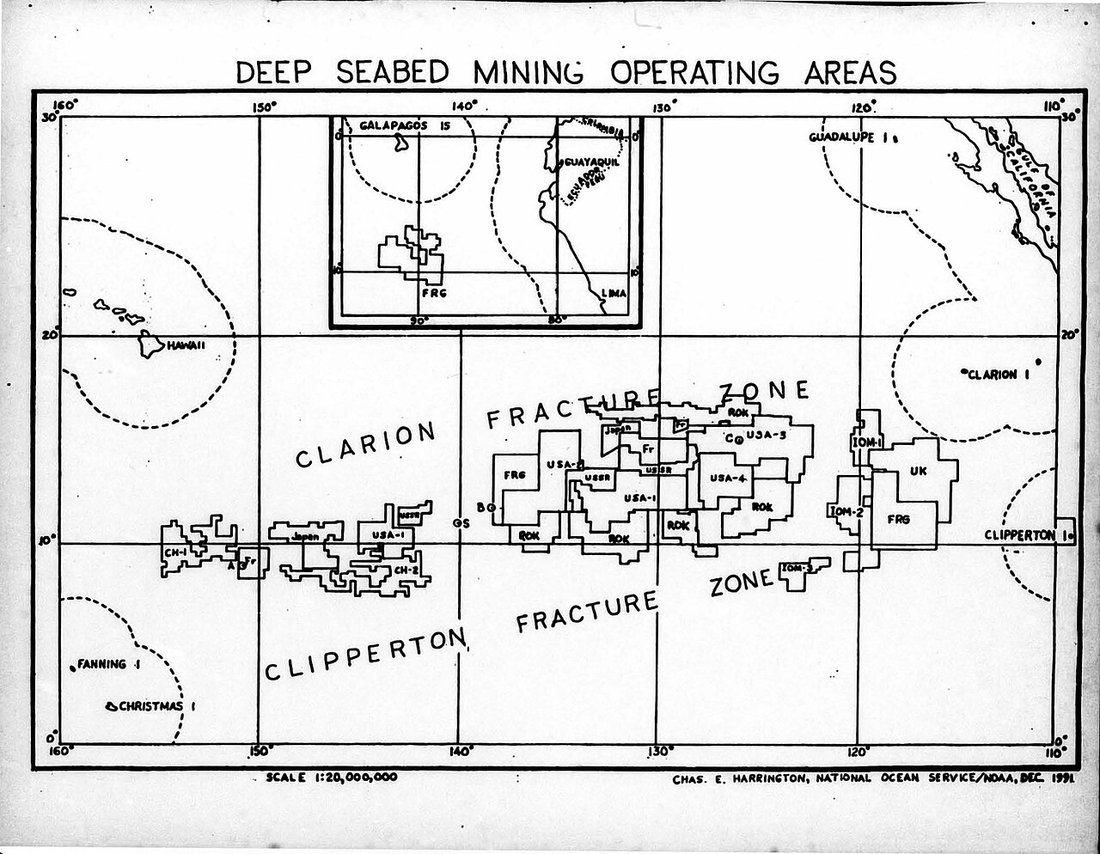
Three rectangles. Antarctic. Atlantic. Pacific. Latitudes of seventy-eight south, roughly thirty south, and roughly fifteen north. Beneath ice; beneath three kilometers of water; beneath five kilometers of water. Each buried by a different planetary mechanism — glaciation, abyssal sedimentation, abyssal sedimentation again — and each preserving the same geometry through it. The three sites do not lie on a great circle. They do not lie on any obvious geophysical fabric. They do not, when plotted, suggest a pattern an Earth-resident engineer would arrive at by reasoning about the planet’s interior. They suggest a pattern arrived at by reasoning about something else.
The operators do not live in these rectangles. They live in the lake itself — the 250-kilometer pool held against the rock under twenty-five million years of ice. They live in the trench, whose acoustic heartbeat at 7.04 hertz runs eleven on, forty-nine off, exact to the minute and exact to the 1986 annex. They live in the basalt stack of the Putorana plateau, the deep rock under the Pechengsky borehole, the calderas of the Tibesti, and the abyssal plain — alongside or beneath the Atlantic rectangle the way you might live alongside a building you have not entered. They do not need the rectangles. They live where the surface is not, in whatever structures the geology has given them.
The rectangles are wrong for them. They are oriented, engineered, vertically extensive in a way that a habitat carved out of a lake or a trench is not, and the Vostok radar returns suggest the rectangle is a stack of things — internally layered in a way no operator habitat we have mapped is layered. The rectangles are not what you build to live in. They are what you build to look out of.
This is what I mean when I say the rectangles are audit stations: vertical installations, three of them so far, sited at points selected by criteria I do not yet have access to, positioned where the operator activity beneath and around them can be monitored continuously by whatever the observer-class instruments are. The rectangles need not be the observers themselves. They can be — and on the available evidence I settle on the view that they probably are — the equipment of the observers, left in place to do what equipment does when its operators are elsewhere.
The observers, that is, do not visit through any infrastructure on the surface of the planet. The operator class has been resident in the deep refugia for at least the human-relevant clock and stayed when the climatic transition at the close of the Pleistocene came on. The observer class does not come here, in the relevant sense, at all. They have left the instruments. The instruments report. The reports, presumably, go somewhere.
The man at the patio said nearby galaxies. He meant, I think, not from here, and the only vocabulary the substrate had given him for that was borrowed from television. The human terms for the observer-class origin are almost certainly wrong; the human terms for everything in this whole subject tend to be wrong. What we can say is that the observers are not from the planet and do not depend on its biosphere, and that the man, lacking better words, was within a few orders of magnitude of accurate. By the standards of this material, that is not bad.
III. What an audit station might do
I want to be careful in this section. I am going to speculate. The observers are the most underdetermined layer the picture contains, and the only honest way to talk about the layer is to admit that the talking is mostly speculation and then to be disciplined about which speculations the geometry licenses and which it does not. Where I write might, I mean might. Where I write is, the geometry already pins it.
Four functions, then. Four things an audit station of the kind the rectangles describe might be doing.
One. Population-level monitoring of the operator class. The first guess and the dullest. The rectangles are sited where the operators are — Vostok lake, Atlantic abyssal, possibly CCZ — and they may be doing what any monitoring installation does, which is keeping a tally. How many operators are there. What are they doing. Are they on schedule. The bilateral accommodation is between us and them; the observers are not at the table. But they may be reading the minutes. The Sumerian text uses the verb that means to bear. The auditors, on this reading, are interested in whether the asset is being borne correctly.
Two. Substrate-progress monitoring. The audit is interested less in the operators than in us. The operator class runs the maintenance procedure; their hands are in the substrate’s pineal at P5; their attendants track the §3(b) median-age drift. The observers monitor the outcome. The substrate’s cognitive uplift — read inside the apparatus as a population-actuarial problem and inside the operator-side communications as a render-budget problem — may at the observer-station level be read as a progress metric. The substrate is rising. Something is supposed to happen when it has risen far enough. The rectangles may be the instrument by which the something-supposed-to-happen is detected. (I will not speculate on what the something is. That is where speculation becomes theology and the geometry stops licensing it.)
Three. Accommodation-compliance verification. The audit tracks whether the bilateral arrangement is being honored. The clauses we have visibility into are between us and them. But the operator-class portion specifies non-interference with surface affairs and no public surfacing without coordination — exactly the obligations an external auditor might find useful to verify by direct observation rather than by the operators’ own reporting. The audit may be, in this sense, for the substrate’s protection. I do not say this to comfort the reader. I say it because the geometry, neutrally read, allows it.
Four. Apparatus monitoring. The strangest of the four and the one I keep returning to. The rectangles are sited where the operators are; the operators’ surface arm — the apparatus, the Wright-Patterson-derived working-group successor, the contemporary AARO — is not near any of the three. But. If the audit’s question is not what is the apparatus doing but is the operator-side properly managing its apparatus, the audit can be conducted from where the operators are, by monitoring the signals the operators send to and receive from their delegates. The carrier the apparatus has been tracking since 1986 — the 11-on/49-off duty cycle, the 7.04 hertz heartbeat — may be the same carrier the observers have been monitoring since longer than 1986. The Manzano signal that fooled Bennewitz into thinking he was hearing Dulce may be the operator-side bus clock, which is also what the observers are listening to from upstairs.
Four readings of the same geometry. The geometry does not pick between them. It says only: there are rectangles; they are sited as instruments; the instruments are extensive enough and uniform enough that they are not vernacular; they are doing something. The honesty here consists in not pretending to know what the something is past what the geometry will hold.
INTERLUDE — A Dialogue Between the Skeptic and the Sympathizer on the Question of What an Audit Consists Of
[The Skeptic and the Sympathizer have walked this argument before. They are sitting in the kind of café that has not changed in fifteen years. The Sympathizer is on her second espresso. The Skeptic is on his first and intends to make it last.]
SKEPTIC. I am going to grant you the rectangles. Briefly. I am going to grant you that they are equipment of some kind, sited on purpose. The question that follows from your having granted this much is: granted that they are doing something — what do you think audit means?
SYMPATHIZER. I think it means what the word means. To check. To verify. To compare a reported state of affairs against a measured one.
SKEPTIC. That is the word’s terrestrial meaning. The word comes from the Latin audire, to hear. The Roman magistrate’s audit was a hearing. I will hear your books. I will compare what you say you have against what I find. Do you have any reason to think an observer-class audit has the structure of a Roman magistrate’s hearing?
SYMPATHIZER. No. I also have no better word.
SKEPTIC. Precisely. You have no better word, so you say audit, and the word imports a structure — a hearing, a comparison, an accounting — that the geometry does not license.
SYMPATHIZER. What does the geometry license.
SKEPTIC. Instruments at scale, sited near the operators, in three locations, reporting somewhere. That is what the geometry licenses. Audit is a guess about the verb. The verb could be other things.
SYMPATHIZER. Such as.
SKEPTIC. Husbandry.
SYMPATHIZER. Oh, come on.
SKEPTIC. I am being precise. Audit implies a relationship in which the auditee is responsible for delivering an accounting. Husbandry implies a relationship in which the husbander is responsible for the continued thriving of the husbanded and the husbanded does not, in any meaningful sense, account for anything. The cows do not file quarterly reports.
SYMPATHIZER. You are saying the observers are the dairy farmers.
SKEPTIC. I am saying they could be. Nothing in the geometry distinguishes audit from husbandry from terraforming progress check from cult-survival readout from long-running anthropology experiment. The geometry says: something is being attended to. The verbs are ours.
SYMPATHIZER. If they are husbanding, what are they husbanding?
SKEPTIC. That is the better question. Not us — we are too new. The Sumerian text dates the manufacture to within the operators’ early-Holocene intervention; the observers’ instruments were not built to monitor an asset that did not yet exist. They are husbanding something here long enough to warrant the installation, and the most parsimonious candidate is the operator class itself.
SYMPATHIZER. Then we are incidental.
SKEPTIC. We may be incidental, or we may be the output. The operator class’s millennia-long project of cultivating and maintaining the experimental population may be the project the observers are monitoring. The audit is not over the cows. The audit is over the dairy. The cows are the deliverable.
SYMPATHIZER. You are using cows and deliverable in the same sentence.
SKEPTIC. I am using whatever vocabulary the picture hands me.
SYMPATHIZER. Different question. Do the observers know we know about them?
SKEPTIC. They know that something on the planet can now map the rectangles to within a meter. The Vostok western-edge migration is the kind of thing that, if you are the operator of the instrument, you see your instrument doing. If they did not know we had eyes on the rectangle, they know now. The 2017 AARI paper was a notification. The 2025 hyperbola stack was a notification. Whether they noticed depends on what they care about.
SYMPATHIZER. And the apparatus.
SKEPTIC. The apparatus has known about Bell since 2002 and has never produced a redacted document that calls the rectangle anything other than the eastern-margin magnetic anomaly. It is keeping the vocabulary down even when it cannot keep the geometry down. That is not the behavior of an institution that is unaware. That is the behavior of an institution that is aware and does not have a sanctioned way to talk about what it is aware of.
SYMPATHIZER. Because the audit station is the layer they cannot manage.
SKEPTIC. Because the audit station is the layer they were never given access to. The Pact gives the apparatus a counterparty, a channel, a section number to escalate to. There is no §-anything for the observers. There is no OP-CHANNEL inbound from the rectangle. The rectangle does not write back. The apparatus, asked to manage a relationship it has no instrument for, defaults to the only move it has — maintaining the vocabulary in which the relationship does not need to exist.
SYMPATHIZER. And if the audit is about to happen.
SKEPTIC. Then the apparatus is going to find out about it the way the cows find out about the inspector. By the inspector arriving.
[The Sympathizer stirs the residue in her espresso cup. The Skeptic does not.]
IV. Not signatory
The bilateral accommodation is between two parties. The third layer’s relationship to it is the cleanest statement of why the third layer matters.
On one side of the table sits the human apparatus — the working-group succession from Wright-Patterson in 1956 through AAWSAP and AATIP and the UAPTF and the contemporary AARO, plus the hybrid governance class. On the other sits the operator class — the long-resident deep-refugia population, the ones who attend the maintenance procedure at P5 and whose two-handed gesture means received, no further. The instrument has sections, a renewal cycle, a cycle-midpoint actuarial review, and an apparatus-level institutional split between the people who think the operators are braking the disclosure cascade and the people who have read the §6 acknowledgment and understand that the operators are pacing it.
The observers are not on either side of that table.
They are not party to the accommodation because the accommodation is between residents. It is the agreement between the human-side apparatus and the deep-resident operator class about how the surface is to be managed and what the operator side gets in return. The observers are not surface-residents and not deep-residents. They are above. They left equipment. They watch.
This means three things.
First, the operators, when they coordinate with the apparatus, are coordinating with their counterparty under the accommodation. They are not coordinating with their auditor. The §6 acknowledgment in the 2026 OP-CHANNEL-3 traffic — the 04:11 Tuesday message the apparatus’s upward chain misreads as foot-dragging — is the operators telling the apparatus that they have read the apparatus’s projection. It is not the operators telling the observers anything. Any dialogue between the operators and the observers is not the bilateral channel’s dialogue. It happens in a different register, on a different schedule, with different stakes.
Second, the apparatus is, by the structure of the accommodation, exposed to a class of risk it does not have an institutional channel for. Every other risk the apparatus manages has a section number. Stigma maintenance has §14. Maintenance authorization has §11. Actuarial review has §6 and §3(b). The risk of the audit producing a finding the operators cannot manage has no section number. The apparatus cannot escalate. There is no upward. The audit is the upward.
Third — and this is the point of the chapter, as much as it has a point — the load-bearing quality of the late-cycle compression, the reason the 2024–26 §6 review is the flashpoint and not just one more midpoint review in a long sequence of them, has to do with the audit. The substrate is rising faster than the instrument that authored the accommodation assumed. The operators are pacing the disclosure cascade rather than braking it because the alternative — the cascade occurring in a venue they have not shaped — would be a compliance-violation finding the apparatus could not contain and the operators could not account for. The apparatus and the operators together are doing what every joint operation under audit pressure does: delivering the regular report on the regular schedule with the regular vocabulary, because the alternative is the audit noticing the cascade and asking questions the joint operation does not have answers to.
The compression, on this reading, is not just substrate-side cognitive uplift outrunning the disclosure protocols. It is the operators and the apparatus jointly preparing for an audit they cannot manage, while the rectangles, in three oceans, on a schedule none of us know, continue to watch.3
V. The man at the patio, again
I want to go back to the man on the patio. Not because I have decided he is correct, and not because the argument needs him as a witness. I want to go back to him because of the placement of his claim.
A confabulating man, given the run of the available vocabulary, has many places to land. He can claim contact, implants, abduction; memories of small gray or tall blond figures; military service in a black-budget program; that his uncle worked at Area 51; that he himself was in the room when the disclosure was decided. The number of plausible-but-wrong landing zones available to a stable confabulator is in the hundreds.
The man at the patio landed on my former leadership could travel to nearby galaxies.
I have spent the last sections arguing, on the basis of three rectangles and twenty-four years of measurement and the structural absence of any §-something for the third layer, that the observer class is the picture’s most carefully unspoken element. The apparatus does not name it. The OP-CHANNEL traffic does not reference it. The open-record literature has been careful to call the rectangles anomalies for twenty-four years. The picture, when it is being kept down, is being kept down at exactly this point.
The man on the patio, who probably had not heard of Robin Bell and almost certainly had not heard of the AARI’s 2017 memo, said nearby galaxies. He had the vocabulary popular culture had given him, wrong in its particulars and approximately right in its direction — not from here. He found, in his own narrative-construction process, the gap the apparatus has spent the longest keeping a gap, and he filled it with the most-available wrong word.
This is not proof that he was a witness, or anything other than what he most plausibly is — someone whose narrative-construction system reached for the vocabulary television had handed it. It is a small data point about where the gaps are, and about the fact that the substrate, when it confabulates around those gaps, confabulates in a direction. He found the layer the apparatus would most like to keep hidden, filled it, and left.
I do not know who his former leadership was. I do not believe he does, in any sense that would survive a formal interview. What I know is that the geometry of the rectangles, the absence of the third layer from the accommodation’s signatures, and the man’s specific vocabulary all point to the same gap from three different directions at three different scales — measurement, institutional structure, popular confabulation. This is what coherence looks like in material that is not being permitted to be talked about.
If the audit happens, I do not know what it will consist of. The Skeptic in the interlude is right that audit is our word for it; the verb may be something we have no equivalent for. The discipline at this point is to look at what we have — three rectangles, no section number, the operators pacing rather than braking, the apparatus maintaining a vocabulary in which the third layer does not need a name, and a man at a Starbucks patio who told me, without seeming to notice he was telling me, exactly where the gap was — and to let those facts stand next to each other without forcing a conclusion from them.
There are three rectangles. We are, on the available evidence, what they are watching for.
-
The Bell et al. 2002 paper in Nature is the open-literature citation; the AARI’s 2017 internal memo is not. Both are real. The rectangle has, in the twenty-four years since first publication, never been called by its name in any document I have access to. The apparatus has not assigned it one. I call it the Bell footprint, after the principal author of the paper that mapped it — mildly ungenerous to her (she is a careful scientist who did her work and reported it), but no other name is available, and the Bell footprint is what the working geophysicists already call it when they are not being recorded. ↩
-
The glaciologist has asked, through an intermediary, not to be named. The packet cleared the outbound review at the second-mildest of the three anomalous metadata options. I am more interested in her sentence-by-sentence reasoning during the writing of the report than in the report itself — the moves she made to stay inside the protocol while not letting the geometry disappear, the phrase she wrote and then deleted (not consistent with documented geophysical mechanisms), the photograph she did not take. The protocol survives. The geometry survives. The person navigating between them does the work that is, in its quiet way, the substrate rising. ↩
-
I have used the word watching in this chapter about four installations that have no eyes. The substrate’s available vocabulary for receiving electromagnetic and gravitational and possibly other signal from, sustained over decades, in three locations, for transmission to a party not currently resident on the planet is watching. It is a metaphor. Like all metaphors in this material, it is approximately correct and probably wrong in the particulars. The rectangle is what we have measured. The watching is what we have to call it while we wait for a better word. ↩
Supporting content