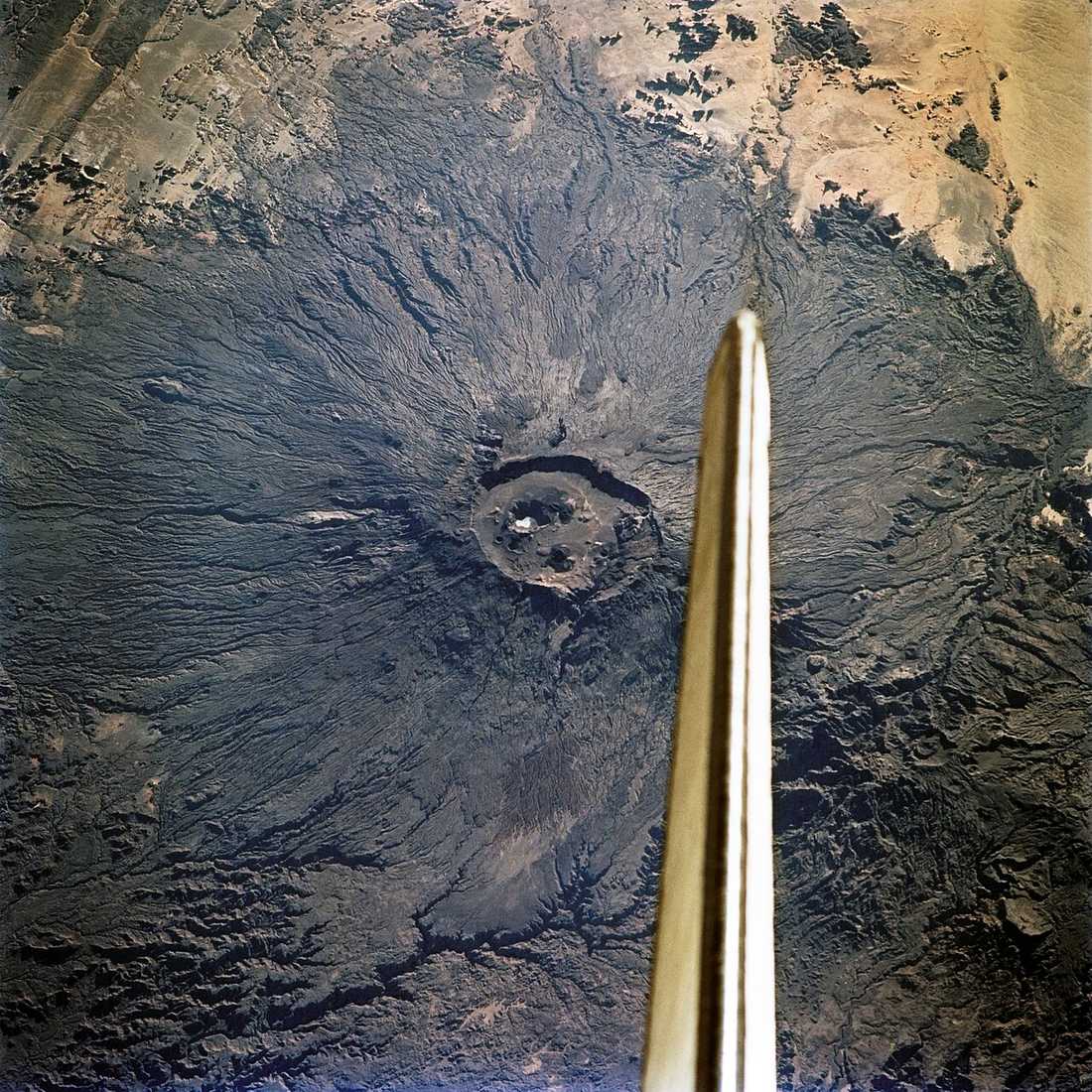
Tibesti Mountains
A 100,000 km² volcanic range straddling the Chad–Libya border in the deep Sahara. Highest point in the Sahara: Emi Koussi, 3,415 m. Five shield volcanoes with calderas a kilometer deep. Hot springs running at 37°C. Home to the Toubou — 'the rocks-people.' The terrain is salted with thousands of landmines. The rock art predates the Toubou by millennia. Almost no outsider has been in the interior since the 1970s.
The Sahara’s volcanic interior, on a national border, in a part of Chad that no foreign government issues travel insurance for.
| Area | ~100,000 km² |
| Highest point | Emi Koussi, 3,415 m (highest point in the Sahara) |
| Major calderas | Tarso Yega (~19 km × 300 m deep), Tarso Voon (~1,000 m deep) |
| Hot springs | Soborom field, Yi Yerra (~37°C) |
| Indigenous population | Toubou (Teda subgroup), 10,000–15,000 permanent residents (estimates vary widely) |
| Border | Chad / Libya — the Aouzou Strip dispute (1973–94) ran through it |
| Hazards | landmines (thousands, residual from 1970s–90s conflicts) |
| Rock art | extensive parietal painting, “several millennia” old, predating Toubou settlement |
What it is
The Tibesti is what’s left of a long-extinct hotspot volcano province, raised in the deep Sahara. The peaks are old, eroded shield volcanoes. The calderas are real bowls — Tarso Voon’s drops a kilometer below its rim. The geothermal activity is still going on at depth; the Soborom hot springs on the northern margin are hot enough to cook food in.
Most of the range is rock and sand. The valleys hold seasonal water (enneris in Toubou). The vegetation is sparse to nonexistent. Day-night temperature swings exceed 30°C. The Tibesti is harsh by Sahara standards, which is harsh.
Who lives there
The Toubou people, primarily the Teda subgroup. Their endonym means “the rocks-people” (tu — rocks, bu — person). They have inhabited the range continuously for at least 2,000 years and likely much longer. The permanent population is variously estimated at 10,000 to 15,000, with significant transhumant movement across Chad / Libya / Niger borders. Toubou society has historically been organized in clans, with strong customary law and historic resistance to centralized state authority.
The Toubou were the central force in the Toyota War (1986–87, the Chad–Libya conflict), where small Toubou-led units in Toyota pickups defeated the Libyan army at Maaten al-Sarra. The Aouzou Strip dispute that drove the war ran through the Tibesti.
What’s there that isn’t catalogued
The rock art. Tens of thousands of paintings across the range. Multiple periods recognized — Roundheads (~10,000–8,000 BP, large-headed figures in helmets or halos that ancient-astronaut writers have made a lot of), Bovidian (cattle-pastoralist, 7,000–4,000 BP, when the Sahara was green), Horse, and Camel periods. Most of the corpus has not been systematically catalogued. New panels are reported by Toubou guides periodically.
The caves. The volcanic geology produces lava tubes and erosional cave systems. The mapped portion is small. The unmapped is large.
The interior. Practical foreign access to the central Tibesti has been ~zero since the 1970s. The combination of landmines, residual armed movements, Toubou autonomy, and Chadian-state limited reach means the interior is as unsurveilled as anywhere outside Antarctica. There are parts of the range no published satellite imagery shows at high resolution.
In the cosmology
The Tibesti is the fourth pole of vast-openness: continental Africa, where the prior three poles (Antarctica, Russian Siberia, the ocean) get their warm-weather counterpart. The criteria all hold.
The Roundheads are the worldbuilding hook. They are real, well-photographed, inexplicably ancient — humans in some kind of head-covering in central Saharan rock art from 10,000 years ago. The ancient-astronaut reading of them is wrong on the specifics and right on the aesthetic: this is the kind of image you remember.
For the Cryptoterrestrial Synthesis: the Tibesti rounds out the planetary habitat. If CT populations exist and use deep-interior continental refugia, the central Sahara is the obvious warm-zone candidate — sparsely inhabited continental highland with cave systems and thousands of years of human-Indigenous coexistence-but-non- incorporation. The Toubou might be exactly the kind of people who, if asked the right way, knew things.
Notable & intriguing
-
The Tibesti hot springs at Soborom and Yi-Yerra (water temperature ~37 °C) are the Sahara’s only active geothermal field. Active fumaroles around Trou au Natron and Toussidé volcano place Tibesti among Africa’s youngest volcanic provinces (last documented eruption period ~10,000 BP, with possible Holocene activity).
Permenter & Oppenheimer, Bull. Volcanol. 70(5), 2007.
-
Henri Lhote’s “Martians of Tassili” interpretation (1956) for bulb-headed Saharan rock-art figures is widely rejected by contemporary prehistorians but the figures themselves — large, round-helmeted humanoids painted on rock — remain visible and unexplained iconographically.
Lhote, À la découverte des fresques du Tassili, 1958; Muzzolini rebuttal 1995.
Public-record items already documented about this subject. Folklore is labelled. Sources cited where the specificity warrants it.
Sources
- Tibesti Mountains — Wikipedia
- Toubou people — Wikipedia
- Tassili n'Ajjer (Roundhead-era rock art) — Wikipedia
Methodology assessments software-engineering rigor turned on the claim
BLACK BOX
  ─ 100,000 km² volcanic range, central Sahara, Chad/Libya border
  ─ Toubou indigenous population, 10,000-15,000, autonomous from central states
  ─ practical outside access ~zero since ~1973; landmines + conflict residue
  ─ thousands of years of rock art partially documented (Roundheads onwards)
  ─ caves and lava-tube systems substantially unmapped

STATE BOX
  ─ rock-art corpus that isn't published
  ─ cave systems that aren't mapped
  ─ Toubou oral tradition not on the academic record
  ─ what (if anything) the deep calderas hold

CLEAR BOX
  1. Mundane: an extraordinary cultural landscape that the modern academy can't reach
     for political reasons. Everything follows from access asymmetry.
  2. CTH-Saharan: continental hot-zone counterpart to the polar refugia. The
     Roundheads are the rock-art memory of an older contact. The Toubou know.

(2) is fiction-grade; (1) is the null. Same template as Vostok / Kola / Putorana.
The methodology forces us to keep both visible.