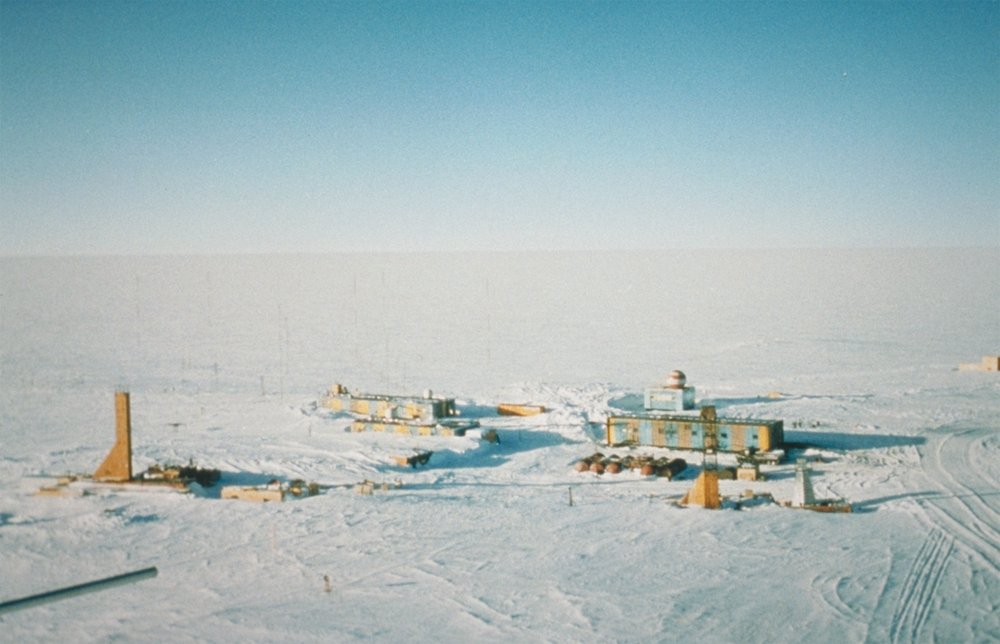
Lake Vostok
250 km long. 50 km wide. Sealed under four kilometers of ice for somewhere between fifteen and twenty-five million years. Water temperature −3°C, held liquid by pressure. The Russians drilled to it with sixty short tons of kerosene and Freon in the borehole. They reached it on February 5, 2012.
Lake Vostok is the largest of Antarctica’s ~400 subglacial lakes and the most sealed body of liquid water on Earth. Specs, in literal numbers, because the literal numbers are the texture:
| Length | 250 km |
| Width | 50 km |
| Average water depth | 432 m |
| Maximum water depth | 510–900 m |
| Depth below ice surface | ~4,000 m |
| Isolation | 15–25 million years |
| Water temperature | −3°C (held liquid by pressure) |
| Surface above lake | Vostok Station, lowest recorded temperature on Earth (−89.2°C, July 1983) |
Above the lake sits the Soviet (now Russian) Vostok Station, established 1957 during the IGY, manned year-round. Reaching the station overland requires a 1,300 km tractor traverse from the coast. Resupply is by aircraft in a window of about three months a year. The remainder, the station is sealed.
The discovery arc. Soviet seismologist Andrey Kapitsa used surface soundings in the 1960s and proposed a lake. J.P. Ridley confirmed its outline in 1993 from ERS-1 satellite altimetry. By the late 1990s the Russians had begun deep ice-core drilling at Vostok Station — the same hole, methodically deeper, year after year.
The drilling fluid. This is the line that sits with you. The Russians used kerosene and Freon as the borehole anti-freeze — about 60 short tons of it in the column above the lake, suspended through the bottom kilometer of ice. The drilling community understood this would mean some contamination on first breakthrough. The contamination was accepted as the cost.
First reach. February 5–6, 2012. The pressure-driven water shot up the borehole and froze, mixing with the kerosene and Freon as it did. Subsequent cores extracted from that frozen refill became the biology samples.
The biology. In 2013 Sergey Bulat and colleagues at the Petersburg Nuclear Physics Institute reported genetic sequences from an organism they could not match to any known database — provisionally named Thermus-adjacent unclassified. Scott Rogers (Bowling Green State University) analyzed ice-accretion cores and reported 3,507 gene sequences across multiple domains including a small number that aligned with anaerobic / hydrothermal-niche organisms. Both sets of findings have been contested as drilling-fluid contamination — and both sets of researchers have defended them as authentic within the limits the contamination allows. The published record is genuinely unresolved.
The magnetic anomaly. Robin Bell and colleagues (Columbia LDEO, 2002 → ongoing) documented a 1-microtesla magnetic anomaly spanning roughly 105 × 75 km on the lake’s east coast. Their interpretation: localized crustal thinning. Their data: published. The shape: rectangular enough to feel uncomfortable.
The geopolitics. Russia maintains exclusive operational access to the lake. British and American projects (Lake Ellsworth, Lake Whillans) targeted other subglacial lakes for clean-access drilling and the data sharing has been limited. The Vostok program publishes irregularly. Western researchers describe the Russian publication pattern as “scant.”
What this means in the CTH cosmology
This is the Antarctic Refugium made concrete. If you asked a worldbuilder to design the single hardest-to-surveil habitable space on Earth, you would design Lake Vostok. It is:
- under 4 km of pre-isolated ice (no overflight detects you)
- in liquid water (signal-attenuating)
- at the bottom of an enormous magnetic anomaly (passive detection further attenuated)
- on territory accessed by exactly one state, whose publication pattern is irregular
The fiction does not have to invent a thing. The fiction takes the public record and gives it the inhabitants.
Worldbuilding hooks: - The drilling on February 5, 2012 — a contact event in CTH canon. The borehole is the breach. The kerosene-and-Freon flush is the response — a sterilization the Russians knew how to deliver, because they had been prepared to. - The magnetic anomaly’s shape — orthogonal artifacts that would be cited as a habitation signature in a CT-aware audit. - The Russian publication scarcity — read as the cordon (cf. Antarctic Treaty) extended through an academic channel. - The biology that won’t go away — the disputed sequences are the right kind of evidence: too contaminated to count as proof, too persistent to dismiss.
Notable & intriguing
-
Lake Vostok was first identified by Russian geographer Andrey Kapitsa using seismic soundings during Soviet Antarctic expeditions in 1959-64; it was confirmed by satellite altimetry and radio-echo sounding in 1993 by a UK–Russian team.
Kapitsa et al., Nature, 1996.
-
The lake water is held above its sea-level freezing point by the ~3,750 m ice overburden — approximately 360 atmospheres of pressure — and is supersaturated with oxygen and nitrogen at concentrations ~50× those of any surface lake.
Siegert et al., Nature, 2001.
-
The Bell-Studinger rectangular magnetic anomaly (~105 × 75 km) on the lake’s eastern shore was first reported in 2001 from aero-magnetic surveys. The corresponding gravity-anomaly signature has been disputed; subsequent interpretations include a crystalline-rock contrast and a buried crater.
Studinger, Bell et al., Geophys. Res. Lett. 28(18), 2001.
Public-record items already documented about this subject. Folklore is labelled. Sources cited where the specificity warrants it.
Sources
Methodology assessments software-engineering rigor turned on the claim
The cleanroom three-box for Lake Vostok, written tight:
BLACK BOX  (the surface we can observe)
  ─ 250×50 km lake, 4 km below ice, isolated 15–25 My
  ─ Russian-exclusive access; publication irregular
  ─ first breach Feb 2012; refill water frozen and sampled
  ─ 1 μT magnetic anomaly on east coast (Bell et al.), 105×75 km, orthogonal-ish
  ─ disputed biological sequences (Bulat 2013, Rogers 2013) that resist clean rejection

STATE BOX  (the inside we cannot directly probe)
  ─ chemistry & temperature stratification of the water column
  ─ presence/absence of hydrothermal vents in the deep basin
  ─ presence/absence of long-residence biology
  ─ presence/absence of artifacts of habitation (CTH prediction)

CLEAR BOX  (mechanisms that could produce the black box)
  1. Geochemistry-only: anomaly = crustal thinning; sequences = contamination
  2. Endemic-biology: long-isolated extremophile populations (no CT involvement)
  3. CTH-refugium: at least one of the lake's basins is or has been a CT habitat,
     consistent with the anomaly shape and the scarcity of Western access

For the fiction we pick (3). The state box that's hardest to falsify is the most
load-bearing for the story: we cannot inspect the lake from outside Russia, the
biology is genuinely disputed, and the magnetic anomaly is real-published.
Relationships
Supporting content