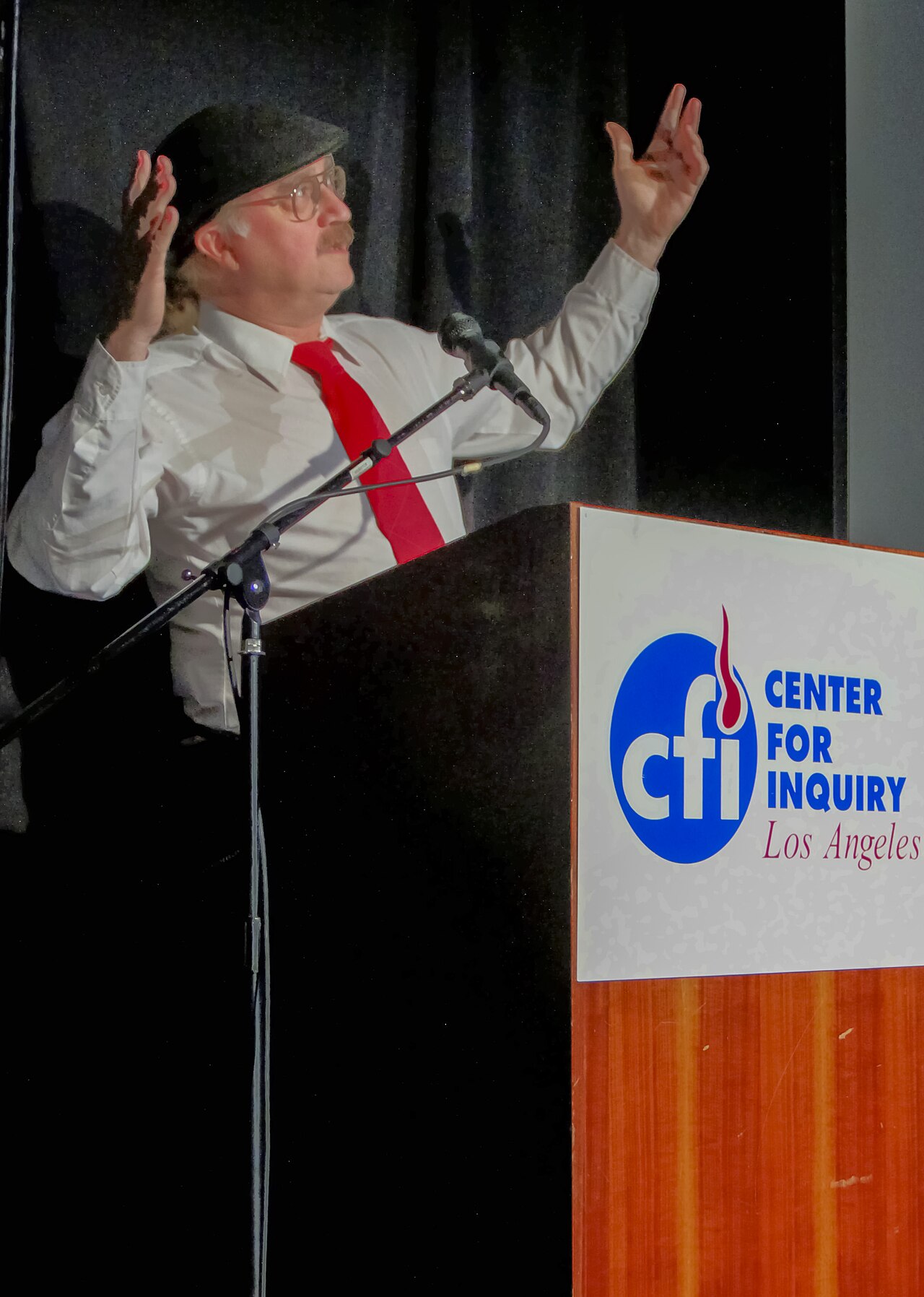
FigureMick West (b. 1965)
aka Mick West (b. 1965) · Mick West · Metabunk · Metabunk founder
British-American programmer, founder of Metabunk (2010), and the contemporary field's most-cited skeptical analyst of UAP video and photographic evidence. Author of *Escaping the Rabbit Hole* (Skyhorse, 2018).
Born in Coventry, England, 1965. Lead programmer of the Tony Hawk’s Pro Skater series at Neversoft Entertainment through the early 2000s; the technical background — frame-by-frame video analysis, real-time rendering math, IR-camera optics — is what equipped him for the work he has become known for. He emigrated to California, retired from the game industry in the mid-2000s, and in 2010 founded Metabunk, an open-forum site dedicated to systematic analysis of viral imagery and conspiracy claims (originally focused on “chemtrails” photographs and later expanded to UAP, JFK, and other domains).
West’s UAP-specific analyses, all posted with full source video, frame data, and reconstruction code at Metabunk, have become reference points the disclosure community is obliged to engage. His Nimitz Tic Tac (FLIR1) analysis argues that the object’s apparent motion is consistent with parallax against the F/A-18’s camera rotation as the ATFLIR pod tracks a distant slow-moving target; the “extraordinary acceleration” is in this reading an artifact of the IR camera’s narrow field and the aircraft’s own attitude changes. His Gimbal analysis argues that the rotating object is an IR glare around a distant, conventional aircraft engine plume, with the apparent rotation produced by the ATFLIR’s gimbal de-rotation servo — the rotation tracks the camera, not the object. His GoFast analysis argues that the seemingly sea-skimming object is an ordinary aircraft at altitude (~13,000 feet), with the apparent low altitude and high speed the result of parallax compression between the camera angle, the moving aircraft, and the distant ocean surface.
For the Phoenix Lights of 13 March 1997, West has built on Tim Printy’s earlier work to argue that the second, stationary set of lights (~22:00) was the LUU-2B/B flare drop of the Maryland ANG’s 104th Fighter Squadron during Operation Snowbird training over the Barry M. Goldwater Range, hanging against the Sierra Estrella mountains — an explanation that has been confirmed for the second set by the unit but not for the earlier moving V-formation. For the 2018 Iraq “Jellyfish UAP” footage released by Jeremy Corbell in 2024, West argues the translucent biological-looking morphology is consistent with a Mylar balloon in IR, the apparent transparency a result of the IR-camera’s thermal contrast inversion.
West’s method, made systematic in Escaping the Rabbit Hole (Skyhorse, 2018), combines thermal/optical reconstruction (modeling the ATFLIR’s pod geometry and the IR camera’s response curve), period-correct flight tracking (cross-referencing ADS-B, FAA NAS records, and military exercise schedules), and frame-by-frame metadata analysis (timestamps, gimbal angles, camera azimuth/elevation). His Metabunk threads typically include the raw video, the reconstruction in Blender or Cinema 4D, and an explicit error budget — what the analysis depends on and where it could be wrong.
He has been an interview subject on the Joe Rogan Experience, 60 Minutes, and the New York Times podcast The Daily; he is regularly cited alongside disclosure advocates in major-outlet UAP coverage. His editorial stance is not blanket denialism. He distinguishes “I can explain this footage with conventional physics” from “I can explain everything” — and he has been explicit that the absence of a prosaic explanation in a given case does not establish an exotic one. He is the figure who keeps the disclosure community’s evidentiary claims technically honest, whether or not those communities credit him. See also: nimitz-tic-tac-2004; gimbal-2015; gofast-2015; phoenix-lights-1997; jellyfish-uap-2018.