Rendlesham Forest Incident disputed-optical-artifact
United States Air Force security police from the twin bases of RAF
Bentwaters and RAF Woodbridge reported lights and, on one account,
a landed craft in Rendlesham Forest across two nights in late
December 1980; the deputy base commander led the second night's
patrol with a Geiger counter and a running microcassette recorder,
and documented the events in an official memorandum to the UK
Ministry of Defence two weeks later.
Of the corpus's 65 historical cases, Rendlesham is the
best-documented multi-night military case. Its anchor is a
contemporaneous official document — the Halt memorandum of
13 January 1981, signed by the deputy base commander, filed
with a foreign defence ministry, and later declassified — backed
by an eighteen-minute audio recording made during the events
themselves. Multiple named airmen are on record across two
separate nights. Two interpretive theories anchor the case
(extraterrestrial, time-traveler), and it is the corpus's primary
laboratory for studying how a witness narrative grows after the
contemporaneous record closes.
Timeline
1980-12-26
At approximately 03:00, security police at the east gate of RAF
Woodbridge observe lights descending into Rendlesham Forest.
Staff Sgt. Jim Penniston, Airman 1st Class John Burroughs, and
Airman 1st Class Edward Cabansag are dispatched to investigate
a possible downed aircraft. In the forest, Penniston reports
approaching a triangular metallic object roughly three meters
across, sitting on or just above the forest floor, with a
glassy black surface and raised markings; he reports making
sketches in a notebook and touching the object's surface before
it moves off through the trees. Burroughs describes lights —
red, blue, and white — but not the close, structured object of
Penniston's account; Cabansag, trailing behind, reports lights
only. The close-approach narrative rests on Penniston alone.
witnesses: Staff Sgt. Jim Penniston (81st Security Police Squadron) · A1C John Burroughs (81st Security Police Squadron) · A1C Edward Cabansag (81st Security Police Squadron)
primary source: Witness statements taken January 1981 (released via FOIA); Halt memorandum 13 January 1981
1980-12-26
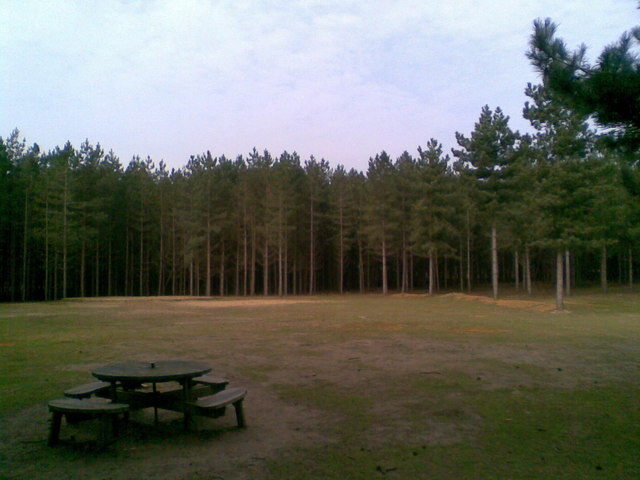
Daylight follow-up. Patrols return to the site and find three
depressions in the ground, roughly 1.5 inches deep and 7 inches
across, in a triangular arrangement, along with what are
described as burn marks and broken branches on nearby trees.
Plaster casts are taken of the depressions; Penniston has
retained casts and has shown them publicly. A radiation survey
of the site records readings of 0.05–0.1 milliroentgens. These
values sit at the bottom of the instrument's range and are
close to ordinary background; the memorandum's later framing of
them as peak readings does not change the absolute values.
Lt. Col. Charles Halt, deputy base commander, is informed of
the events.
witnesses: Staff Sgt. Jim Penniston (site revisit, plaster casts) · A1C John Burroughs (site revisit) · Lt. Col. Charles Halt (briefed; later verified the site)
primary source: Halt memorandum 13 January 1981; Penniston's retained plaster casts
1980-12-27_to_1980-12-28
Night two of the principal events. During a combat-support
social function, a security policeman reports the lights have
returned. Halt assembles a small patrol and enters the forest
to, in his later words, put the matter to rest. The patrol
carries an AN/PDR-27 Geiger counter and Halt's microcassette
recorder, which runs intermittently through the investigation —
the resulting ~18-minute 'Halt tape' is a contemporaneous audio
record. The tape captures radiation readings at the landing
site, the patrol's sighting of a red sun-like light through the
trees ('it's coming this way... it's dripping' — Halt describes
material falling from the object), and later star-like objects
to the north and south that move sharply and, per Halt, send
narrow beams of light to the ground — one reported near the
weapons storage area at RAF Bentwaters.
witnesses: Lt. Col. Charles Halt (deputy base commander, 81st Combat Support Group) · MSgt. Bobby Ball (patrol member, heard on tape) · SSgt. Monroe Nevels (disaster preparedness, Geiger counter operator) · Lt. Bruce Englund (patrol member)
primary source: The Halt tape (microcassette, night of 27–28 December 1980)
1981-01-13
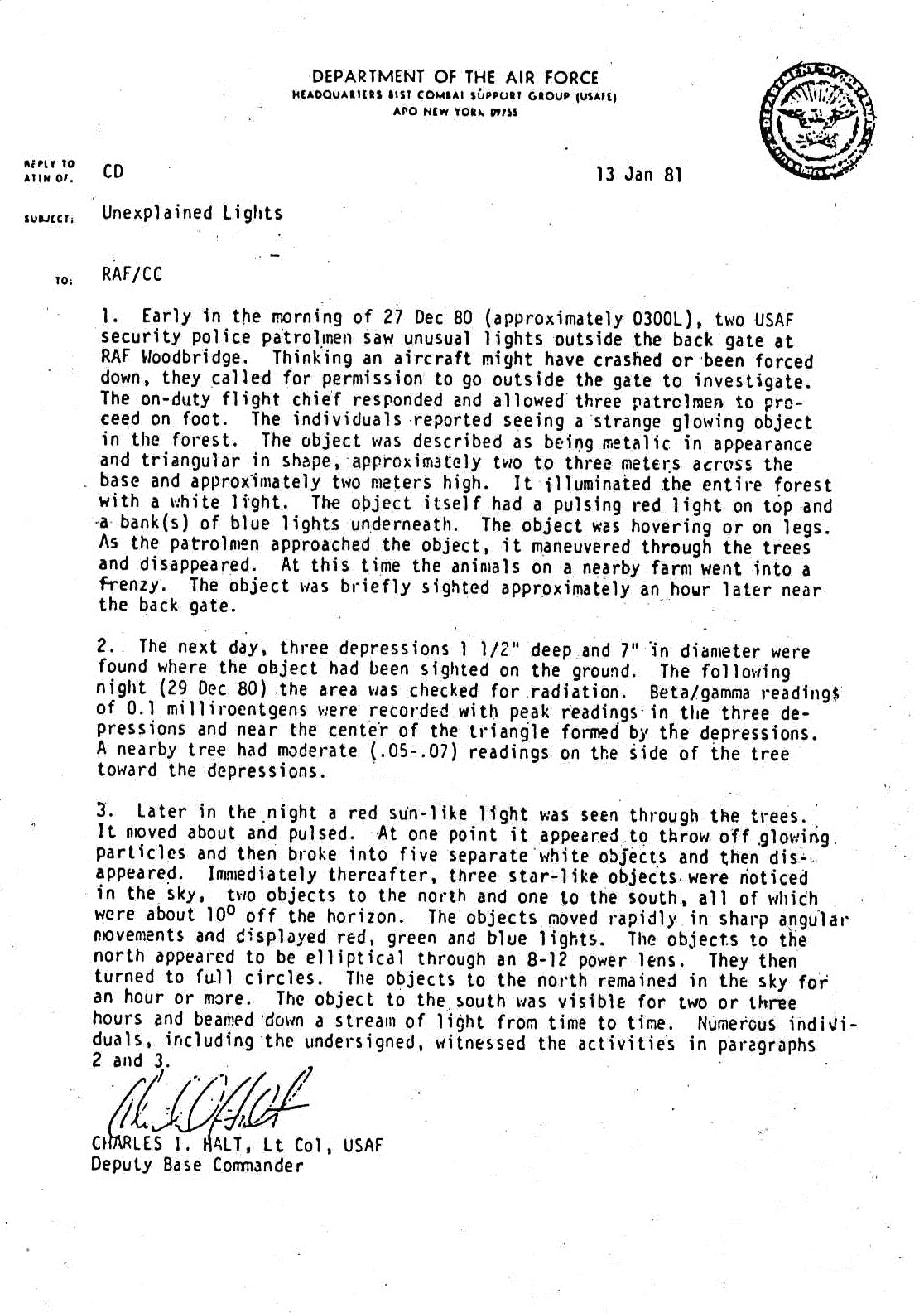
Halt signs a one-page memorandum titled 'Unexplained Lights'
and sends it to the UK Ministry of Defence. It is the single
most important document in the case: an official account of
both nights, written by the deputy base commander, two weeks
after the events. It is real and declassified. It also contains
date errors that are part of the record — it places the first
sighting 'early in the morning of 27 Dec 80' (the first night
was 26 December) and compresses the gap between the two nights.
Halt has attributed the discrepancies to writing from memory
and secondhand notes weeks later.
witnesses: Lt. Col. Charles Halt (author and signatory)
primary source: Halt memorandum, 'Unexplained Lights,' 13 January 1981 (declassified 1983 via U.S. FOIA)
1983-10
The Halt memorandum, released under the U.S. Freedom of
Information Act, reaches the British press. The News of the
World runs it on the front page ('UFO lands in Suffolk — and
that's official'). The case enters the public record; from this
point forward, witness accounts and published reconstructions
begin to diverge from the contemporaneous documents.
witnesses: Lt. Col. Charles Halt (confirmed authenticity of the memo)
primary source: News of the World, 2 October 1983; U.S. FOIA release of the Halt memo
1983_onward
Astronomer Ian Ridpath, working with forester Vince Thurkettle,
publishes the principal skeptical analysis: the Orfordness
lighthouse lies on the same bearing from the forest edge as the
reported lights; a bright fireball was recorded over southern
England at 02:50 on 26 December, minutes before the first
sighting; and the ground depressions match rabbit diggings
common in the plantation. Ridpath has maintained and updated
the analysis continuously since.
witnesses: Ian Ridpath (investigator, not an event witness) · Vince Thurkettle (forester, site examination)
primary source: BBC Breakfast Time broadcast 1983; ianridpath.com/ufo, maintained analysis
2001
The Ministry of Defence releases its Rendlesham file in
response to an open-government request by researcher Dr. David
Clarke. The file shows the MoD's position throughout: the
events were judged of 'no defence significance,' and no
substantive field investigation was conducted. The full file
was transferred to The National Archives in 2010 as DEFE
24/1948.
witnesses: Dr. David Clarke (requester; documents researcher)
primary source: UK MoD Rendlesham file; The National Archives DEFE 24/1948
2003
The Sci Fi Channel commissions a field investigation of the
landing site for its documentary coverage of the case,
returning Penniston, Burroughs, and Halt to the forest and
conducting a site survey. The investigation produces no
physical findings that alter the documentary record but marks
the case's consolidation as a media fixture.
witnesses: Jim Penniston, John Burroughs, Charles Halt (participants)
primary source: Sci Fi Channel investigation and documentary, 2003
2010-06
Halt signs a notarized affidavit affirming his account of the
December 1980 events and stating his belief that the objects
observed were under intelligent control and that both U.S. and
UK authorities withheld information. The affidavit restates,
thirty years on, the core of the 1981 memorandum while going
beyond it in interpretation.
witnesses: Col. Charles Halt (ret.)
primary source: Halt notarized affidavit, June 2010
2010s
Penniston discloses what he describes as pages of binary digits
he wrote down after touching the object in 1980, later
'received' in full and decoded by others into coordinates and
messages. The binary material is a later, contested addition:
it appears nowhere in the contemporaneous record — not in his
January 1981 statement, not in the Halt memo, and not in the
earliest public accounts — and parts of it surfaced in
connection with regression hypnosis sessions. The corpus
records it as a post-2010 layer on the original testimony, not
as part of the 1980 evidence base.
witnesses: Jim Penniston (sole source for the binary material)
primary source: Penniston public presentations and 'The Rendlesham Enigma' (2019); absence from the 1981 record is documented in the FOIA witness statements
Named personnel
- Staff Sgt. Jim Penniston — Security police shift supervisor, 81st Security Police Squadron; led the night-one approach rank at time: Staff Sergeant · later: Principal public witness; author of later notebook and binary-code disclosures primary witness to: the claimed close approach and physical contact with the object, night one
- A1C John Burroughs — Security police, 81st Security Police Squadron; night-one patrol rank at time: Airman First Class · later: Granted U.S. VA disability in 2014 for conditions he attributes to the encounter; public witness primary witness to: the night-one lights; present near but not at Penniston's claimed close approach
- A1C Edward Cabansag — Security police, 81st Security Police Squadron; night-one patrol rank at time: Airman First Class · later: Largely out of public life; his 1981 statement describes lights only primary witness to: the night-one lights, from a trailing position
- Lt. Col. Charles Halt — Deputy base commander, 81st Combat Support Group, RAF Bentwaters rank at time: Lieutenant Colonel · later: Retired as Colonel; signed 2010 notarized affidavit; regular on-record witness primary witness to: the night-two patrol; author of the tape and the memorandum
- Col. Gordon Williams — Wing commander, 81st Tactical Fighter Wing (the Bentwaters/Woodbridge twin-base complex) rank at time: Colonel · later: Named in early garbled press accounts as having met occupants; he was not a witness and has said so role: Senior officer in the reporting chain above Halt
- Ian Ridpath — Principal skeptical investigator of the case (astronomer and science writer; not a witness) rank at time: · later: Maintains the standing lighthouse / fireball / rabbit-digging analysis, 1983–present role: Author of the strongest conventional account of the events
Sensor record
- Mark 1 eyeballs on USAF security police patrols, two nights lights on both nights from multiple named airmen; one close-range structured-object report (Penniston, night one, single witness at that range) documentation: January 1981 written witness statements; the Halt tape; later interviews
- AN/PDR-27 Geiger counter on Halt patrol, night of 27–28 December (operated by SSgt. Nevels) readings of 0.05–0.1 milliroentgens at the landing site — at the low end of the instrument's range and near ordinary background documentation: Readings called out in real time on the Halt tape; figures repeated in the Halt memo
- Microcassette recorder on Carried by Lt. Col. Halt during the night-two patrol approximately 18 minutes of contemporaneous audio: radiation callouts, the 'it's coming this way... it's dripping' sequence, and the patrol's running commentary documentation: The Halt tape; copies circulated from 1984; transcripts published
- Ground radar (claimed) on RAF Bentwaters; later claims reference Heathrow and Eastern Radar (RAF Watton) Halt and others have stated objects were tracked on radar during the period; the MoD file contains a Watton log reference to a Bentwaters query about an uncorrelated target documentation: Weak and disputed. No radar recording or plot has entered the public record; the claims rest on recollection and a brief log entry
Object — reported
shape
night one (Penniston account): triangular, glassy black surface, raised glyph-like markings; night two (Halt patrol): a red sun-like light with a dark center, later star-like points
size
approximately 3 meters across at the base (Penniston estimate, night one)
surface features
smooth, opaque, warm to the touch with no visible seams, engine, or landing gear (Penniston, single witness); the night-two objects showed no resolved structure
observed behaviors
- descent into the forest interpreted by the tower and gate guards as a possible aircraft crash (night one)
- silent movement back through the trees and rapid departure (Penniston account)
- three ground depressions in a triangular arrangement found the next morning at the claimed site
- a red pulsing light that appeared to throw off glowing material — the 'it's dripping' sequence on the Halt tape
- star-like objects exhibiting sharp angular movement and beams of light directed at the ground, one reported near the Bentwaters weapons storage area
- the weapons-storage beam is the single most operationally significant claim in the case; it appears on the tape and in Halt's later accounts but in no independent base security record made public
Theories that invoke this case (2)
The standard ETH reading, and Rendlesham is one of its anchor
cases in the corpus. A structured craft at ground level, a
physical trace site, and an official memorandum constitute the
ETH's preferred evidence pattern: hardware, traces, paper.
The reading requires accepting the close-encounter account of
a single witness at the critical range.
The corpus's TTH entry anchors Rendlesham. The invocation comes
from Penniston's later claims — under regression hypnosis in
the 1990s and in his post-2010 binary-code disclosures — that
the visitors were humans from a distant future. None of this
appears in the contemporaneous record; the theory anchors the
later testimony layer, not the 1980 documents, and the corpus
flags it as such.
Theories that do NOT invoke this case — and why
an honest gap: the case's skeptical literature (lighthouse bearing plus expectation across consecutive nights) is effectively a psychosocial account, and its proponents treat Rendlesham as a showcase — but the corpus theory entry does not formally anchor the case, so it is recorded here rather than above
no candidate 1980 platform has been proposed that matches the reports, and a clandestine test against a NATO weapons-storage base is not part of any published BPH claim
no entity contact, abduction phenomenology, or spiritual-deception element in the record
ball-plasma accounts have been floated informally for the night-two lights, but no proponent has developed Rendlesham as a plasma case; the structured-object report is outside the theory's scope
Conventional explanations advanced — and their status
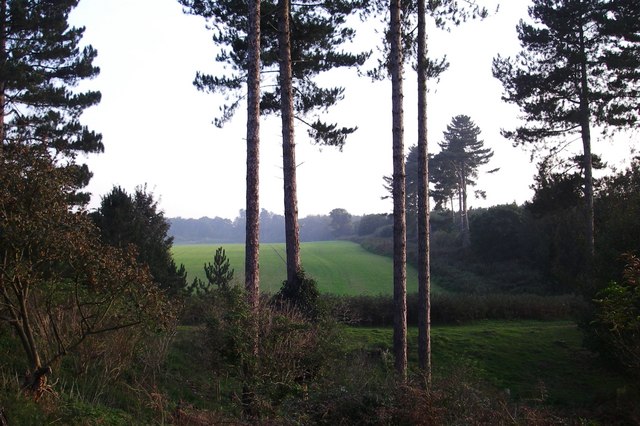
The Orfordness lighthouse, seen through the trees from the forest edge
proponents: Ian Ridpath · Vince Thurkettle · the night-one witnesses themselves
The strongest conventional account — and on 2026 re-audit it explains the CORE, not just the periphery. DECISIVELY, the contemporaneous January 1981 statements of Burroughs and Cabansag themselves identify the pursued light as the lighthouse ('we followed it for about two miles before we could see it was coming from a lighthouse') — the original witnesses recognizing it in real time, not a skeptic's external reconstruction. The lighthouse lies on the reported bearing, its five-second flash matches the 'winking' on the Halt tape, and undulating terrain makes it appear to hover near ground level between trees. It fits Penniston's touchable-craft claim poorly — but that claim rests on a single witness and surfaced largely post-1994 hypnosis, so the mismatch is with the late accretion, not the 1980 evidence.
A bright fireball over southern England at 02:50 on 26 December as the trigger for the initial sighting
proponents: Ian Ridpath
Documented. A bright meteor was independently recorded at that time, minutes before the east-gate guards reported something descending into the forest. As an explanation for what first drew the patrol out, it is well supported; it explains nothing that happened inside the forest.
Bright stars — Sirius in particular — for the star-like objects of the Halt patrol
proponents: Ian Ridpath · various skeptics
Plausible for the long-duration star-like points Halt reported to the south, whose positions are broadly consistent with bright stars scintillating near the horizon. It does not address the reported beams of light to the ground.
Hoax — Kevin Conde's claim of a prank using a patrol car's lights and loudspeaker in fog
proponents: Kevin Conde (self-reported)
By Conde's own account his prank was at a different gate and not on the nights in question; he has said he does not claim to explain the main events. It documents that pranks occurred on the base, which bears on witness expectation, and no more.
Psychological and expectation effects compounding across the nights
proponents: various skeptics; implicit in Ridpath's reconstruction
The connective tissue of the conventional account: a fireball primes the first patrol, the lighthouse sustains the search, the morning's depressions are read as a landing site, and by night two the patrol goes out expecting to find something. It is consistent with the record's growth pattern but is not independently testable, and it must carry the burden of the contemporaneous tape and memo.
Where further investigation has leverage
- Forensic dating and ink analysis of the Penniston notebook, whose internal dates and times conflict with the rest of the record.
- Material analysis of the surviving plaster casts and any retained soil or vegetation samples from the site.
- Public release of the 81st Security Police Squadron blotter and any base incident logs for 25–28 December 1980, which have never surfaced in full.
- The original microcassette: chain of custody and audio forensics on a first-generation copy of the Halt tape.
- Any Eastern Radar (RAF Watton) or Bentwaters radar records beyond the single log reference in the MoD file; the radar claims currently rest on recollection.
- The complete set of January 1981 witness statements, including those of the on-duty flight chiefs, examined against the later published accounts.
Corpus status
disputed-optical-artifact
Reclassified from phenomenologically-open to disputed-optical-artifact on a 2026
adversarial re-audit. The earlier 'open' framing rested on the claim that the
conventional account explains the periphery well and the CORE poorly. The re-audit's
decisive finding overturns that: the conventional composite explains the core too —
because the night-one witnesses (Burroughs, Cabansag) THEMSELVES identified the pursued
light as the Orfordness lighthouse in their contemporaneous January 1981 statements,
the lighthouse's 5-second flash matches the Halt tape, and a documented 02:50 fireball
on 26 Dec drew the first patrol out. The radiation readings are near background; the
ground marks are consistent with rabbit diggings. The genuinely anomalous-sounding
residue — Penniston's touched glyphs, binary code, and 'time travelers... they are us'
— is a post-hoc accretion that surfaced only after 1994 hypnosis, is absent from every
contemporaneous document, and is doubted even within ufology: the case's own original
pro-UFO investigator, Jenny Randles, recanted ('no unearthly craft were seen in
Rendlesham Forest'). That deterioration pattern is the opposite of an open phenomenon.
The contemporaneous Halt memo and tape remain genuine and are retained in the record;
not a documented-hoax, because the mechanism is misperception under expectation, not
deception.
status history (2)
2026-06-09 · unannotated → phenomenologically-open
— annotated before the 2026-06-09 sweep; history begins at seeding
2026-06-14 · phenomenologically-open → disputed-optical-artifact
— adversarial re-audit — The conventional composite explains the CORE, not just the periphery: the night-one witnesses (Burroughs, Cabansag) THEMSELVES identified th
Suggested watching
episode · 2017 · Discovery+ / various
UFO: The Lost Evidence — Rendlesham
Halt, Burroughs, and Penniston on camera; the Halt Memo shown in facsimile.
episode · 2008 · various / YouTube
Britain's Closest Encounters — Rendlesham
ITV walks the forest sites with Halt and the original security police.
Threads of evidence
This case is one node in the connections that run across the record. It appears in 1 thread: